
The Spotlight Effect
Theory 3/10, Are we the main character of everyone's life?

We are the main character of our lives. But so is every one — of their own.

We all at some point, have felt it and some of us feel it constantly.
The effect was first studied by psychologists, Thomas Gilovich, Victoria Medvec and Kenneth Savitsky in 2000.
Let’s understand this effect with an example:
-Supposedly you wore a T-shirt with an embarrassing graphic in college and it's too late to actually go back and change.
-When you reach your class, all you can think about is how everyone is staring at your T-shirt, how people are whispering and laughing about it or that maybe everyone will remember it for weeks!
But the reality is, everyone is too busy living their own life, worrying about their own embarrassing T-shirt (iykyk).
Even if people saw what you were wearing, no one really noticed.
Gilovich’s actual experiments around such scenarios confirmed that:
People experiencing embarrassment in their own heads - estimated that 50% of the room noticed. But in reality, not even 25% did. That in itself is an overestimation.
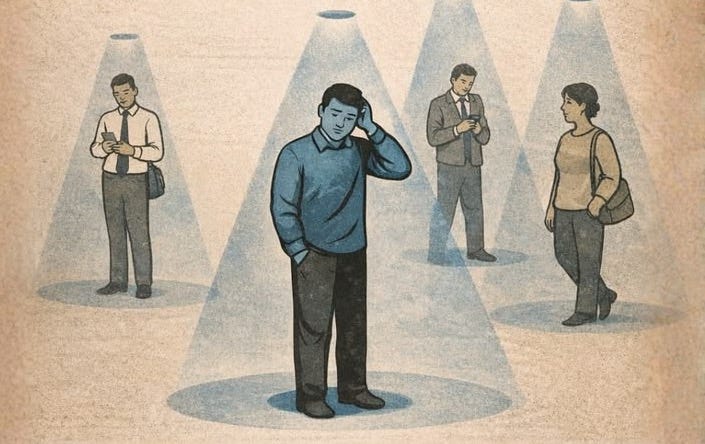
This happens because we tend to live in our own heads, and until and unless we don't make mistakes and learn from them, we will never come out of our head and live our life fully.
I always say this to everyone around me as well - that by training our brain, we can do anything!!!! and so, by training our brain in the right way, we can get away with feeling insecure all the time.
When we are constantly insecure, we question ourselves more and more.
We start monitoring how we look, what we say, what others think, et cetera.
This leaves less mental bandwidth for the crucial things in life like focus, creativity, memory and performance.
Do you know why we are faced with Spotlight effect in our lives?
Egocentric Anchoring: Our egocentric bias takes up our own experiences, our own feelings, appearance, et cetera. And since our experiences are the centre of our world, & so are we (the centre of our own world), we use that perspective as an anchor for judgement, and then we fail to understand that not everybody sees us the way we see ourselves.
Illusion of Transparency: This attribute is related to the spotlight effect only. When we are embarrassed, we think it's written all over our face far more than it actually is. We are left feeling that everyone can see it on us.
When we feel something, we start associating everything and everyone in our surroundings with it.Failure of Perspective: Our brain only registers how we look and feel & it only knows us inside out. But it struggles to understand a stranger’s perspective. Hence it fails to perceive from anyone else's point of view.
Availability Heuristic: Because our own flaw or mistake is extremely fresh, recent and vivid, it is available in our own memory. And it is so vivid, that because it feels big to us, our brain assumes that it feels big to others as well.
Self-Focused Attention: This is cranked up when we are stressed or anxious about a situation. So in such a situation, we keep replaying our embarrassment in loop and the more we think about our embarrassment, the more we feel that the world is thinking about it too.

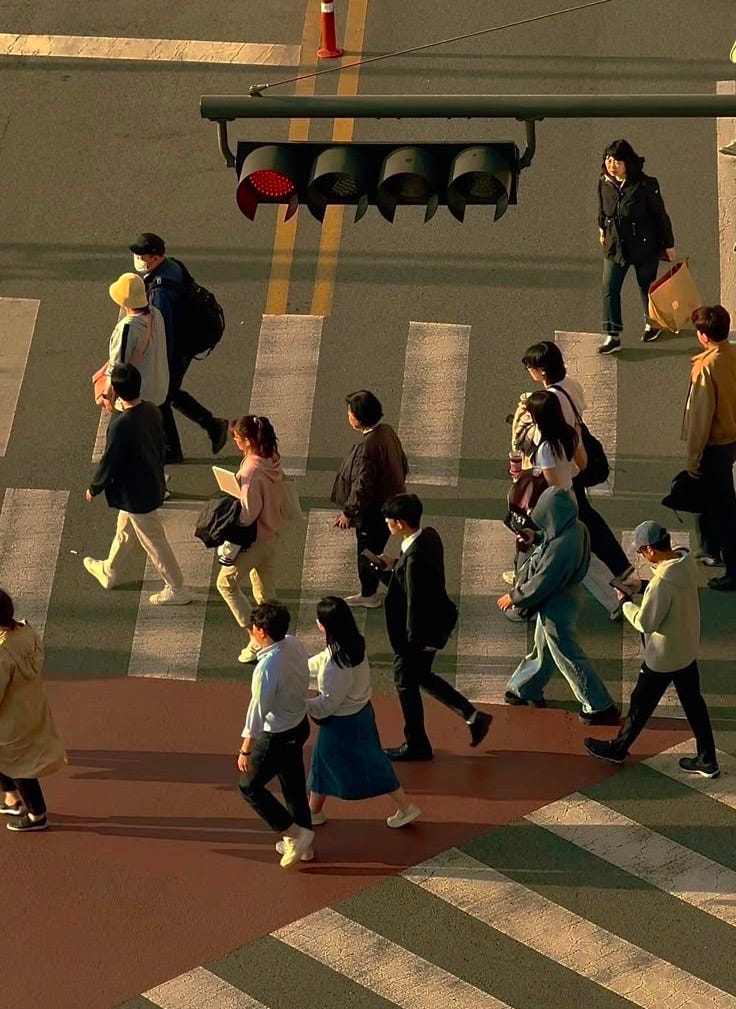
DID YOU KNOW?
Our Cortisol (stress hormone) is also related to us experiencing the Spotlight Effect. Its level increases when we feel self-conscious due to embarrassment.
Even an imagined social evaluation is enough to stress our brain.
When Spotlight Effect becomes chronic, it increases low-grade anxiety.
After our brain perceives social exposure as threatening, it starts pushing us towards avoidance. Overtime our confidence erodes and our comfort zone shrinks.
This also makes us more vulnerable and we are then stuck in the loop until we train our brain to think of embarrassment as only a mere feeling and something that is just a part of life.

Simply being aware of the Spotlight effect on us can dampen its effect.
Self Awareness plays a major role in our daily life.